


The Foundation Behind High-Performance Manufacturing Facilities
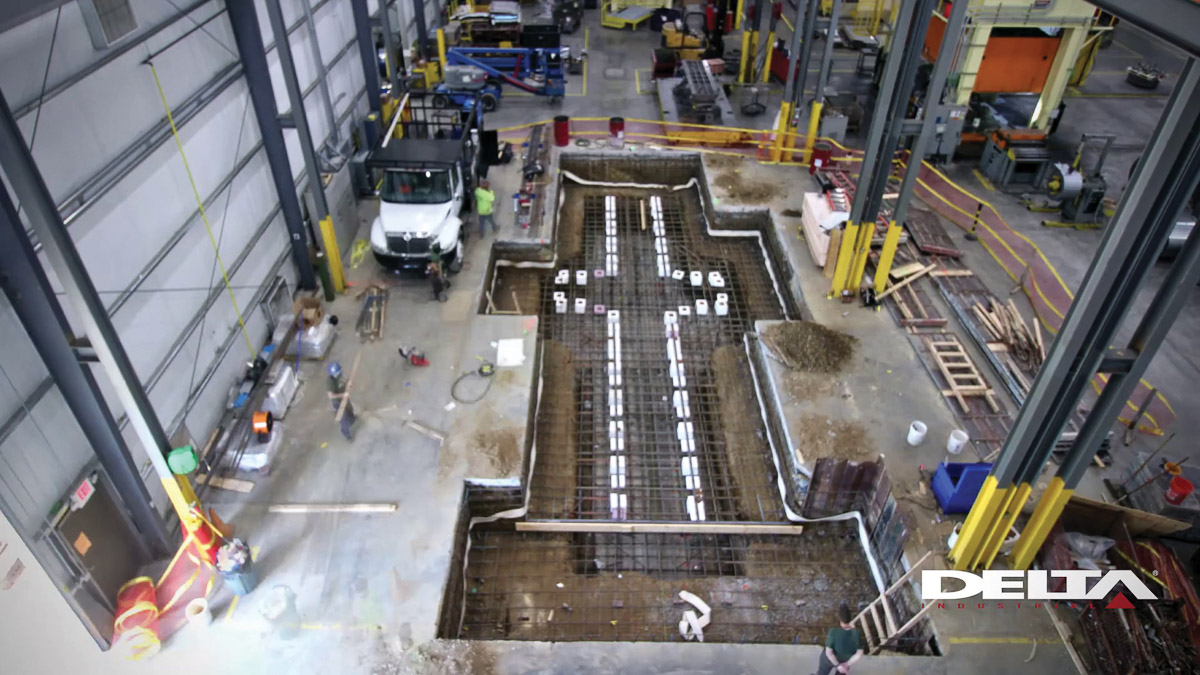
When you think about productivity in a manufacturing facility, your mind probably goes straight to machines, automation, and workforce efficiency. But there’s something even more fundamental at play—your facility’s foundation.
For industries like metal stamping, forming, and fabrication, the quality of your foundation directly impacts performance, safety, and long-term costs.
This article will explore how using a design-build approach and planning for future growth, manufacturers can reduce downtime, extend equipment life, and create spaces built to handle the demands of modern production.
Why Foundations Matter More Than You Think
Heavy equipment like stamping presses, bridge mills, and heat-treat furnaces demand more than just a concrete slab. They require carefully engineered foundations that can:
- Absorb vibration
- Support extreme loads
- Maintain precise alignment
- Withstand years of continuous operation
A poorly designed foundation can lead to misalignment, premature equipment wear, increased downtime, and costly repairs.
The Design-Build Advantage
Modern manufacturing projects are increasingly turning to the design-build approach, where engineering, planning, and construction are fully integrated from day one.
Instead of juggling multiple vendors, this method creates a single, unified team focused on shared goals resulting in:
- Faster project timelines
- Fewer communication gaps
- Better cost control
- More innovative problem-solving
For manufacturers, that means fewer surprises and a smoother path from concept to production.
What Goes into a Machine-Ready Foundation?
Building a foundation for industrial equipment isn’t just about pouring concrete. It’s a multi-phase process that often includes:
- Excavation and shoring to stabilize surrounding soil
- Installation of embedded steel for structural reinforcement
- Precision placement of anchor bolts and leveling systems
- Specialized concrete pours designed for durability and load-bearing
- Integration of trenches, pits, or scrap tunnels for workflow efficiency
Every detail must be exact. Even small errors can affect machine accuracy and long-term performance.
Real-World Applications Across Manufacturing
High-Tonnage Presses
Large stamping presses, like 1,200- to 1,500-ton systems, require deep, vibration-resistant foundations with integrated die support, coil handling systems, and trenching. These setups are essential for maintaining precision in high-volume production.
Heat-Treat Facilities
Furnaces used in aerospace, automotive, and defense manufacturing demand stable, heat-resistant foundations paired with extensive surrounding infrastructure like truck wells and exterior paving for logistics.
Large-Scale Machining Equipment
Bridge mills and other precision machining systems rely on foundations that minimize vibration and maintain exact tolerances, even under heavy loads and continuous use.
Planning for Expansion and Upgrades
As production demands grow, many facilities face the challenge of adding new equipment within existing spaces. This often involves:
- Working around existing footings and utilities
- Managing tight layouts
- Incorporating waterproofing and drainage systems
- Maintaining operations during construction
With the right planning, even complex retrofits can improve workflow, increase throughput, and reduce downtime.
The Long-Term Payoff
Investing in a properly designed and built foundation isn’t just about supporting equipment, it’s about protecting your entire operation.
The benefits include:
- Increased equipment lifespan
- Improved production accuracy
- Reduced maintenance costs
- Greater operational efficiency
- Safer working conditions
Building for the Future of Manufacturing
As manufacturing technology continues to evolve, facilities must adapt just as quickly. From automation to larger, more complex machinery, the demands on industrial infrastructure are only increasing.
A strong, well-engineered machine foundation ensures your facility is ready—not just for today’s production needs, but for whatever comes next. Contact us today!